

Laminated Root Rot Removal
Starting October 26, tree contractors and City staff will begin management of laminated root rot (LRR) with the planned removal of selected Douglas-fir trees in Oliver Woods Park, Salal Park, and Westwood Lake Park.
Laminated Root Rot (LRR)
Laminated root rot (Coniferiporia sulphurascens) is a naturally occurring fungal disease that affects several conifer species in coastal forests, particularly Douglas-fir trees. The disease spreads through root-to-root contact and gradually decays structural roots and the lower trunk of infected trees.
Because infection occurs below ground, affected trees can appear healthy for many years before showing visible signs of decline. As root decay progresses, tree stability is reduced, increasing the potential for tree failure during wind events or other environmental stresses.
Recent assessments conducted within several Nanaimo parks identified areas where laminated root rot is affecting Douglas-fir trees located near trails, roads, gathering areas, neighbouring properties, and other public-use spaces.
Disease Characteristics and Risks
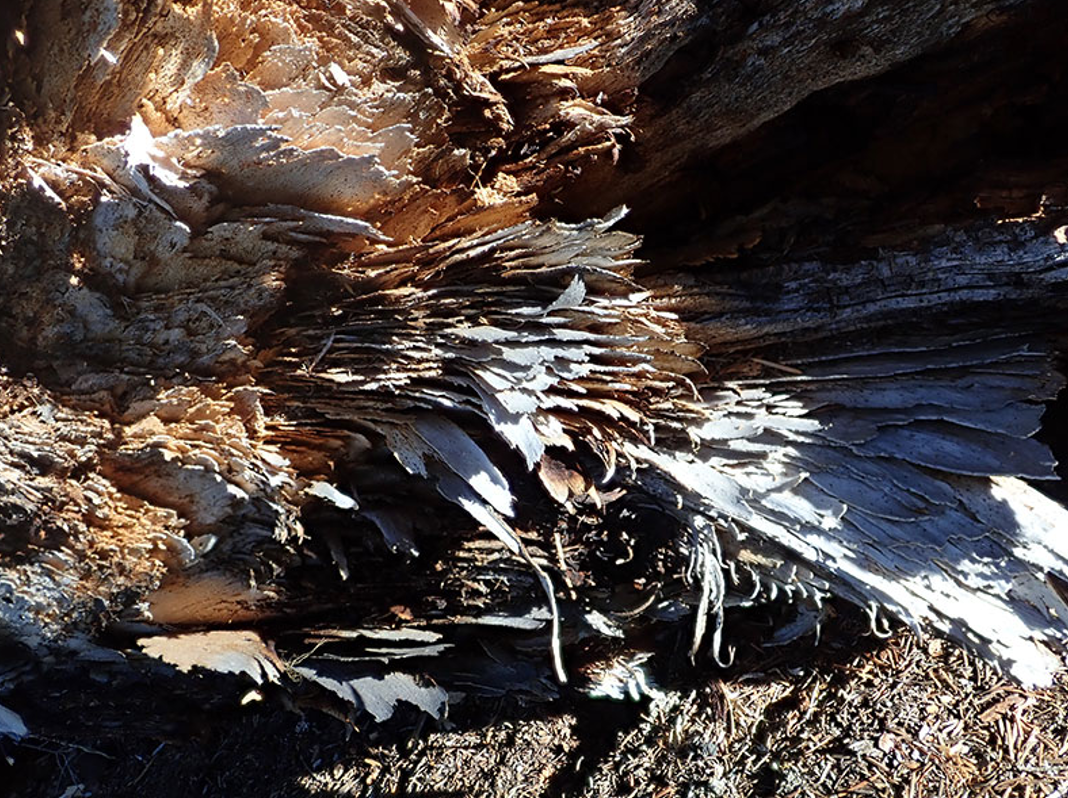
Laminated root rot causes a distinctive wood decay pattern within roots and lower stems. Common indicators observed in stumps, roots, or fallen trees include:
- Wood separating into thin layers along annual growth rings ("laminated" decay).
- Softened or stringy wood fibres.
- Yellow to tan discoloration of wood.
- Small canoe-shaped pits within decayed wood.
- White to cream-coloured fungal growth on roots.
- Advanced root deterioration resulting in weakened structural integrity.
The fungus breaks down lignin within wood, reducing the strength of root systems over time. As a result, trees may become susceptible to windthrow or stem failure even when the crown appears healthy and vigorous.
Tree Assessment
City staff, certified arborists, forestry professionals, and forest pathology specialists have undertaken extensive investigations to better understand the presence and impacts of laminated root rot within Nanaimo parks.
Assessment methods included:
- Root collar excavations to inspect root systems and identify signs of fungal activity.
- Stump inspections to examine decay characteristics associated with laminated root rot.
- Hand drilling to detect hidden decay within roots and lower stems.
- Resistograph testing to measure internal wood resistance and identify structural deterioration not visible from the exterior.
Tree Risk Mitigation and Tree Removal Program
Based on recent assessment findings, selective tree removal is planned within:
- Oliver Woods Park
- Salal Park
- Westwood Lake Park
The objective of the removals is to reduce the risk of tree failure in high-use areas while retaining as much existing forest canopy as possible. The removal program focuses on identified high-risk trees rather than broad-scale forest clearing.
Management Approach
The City is actively managing laminated root rot to:
- Reduce the risk of tree failure near trails, roads, playgrounds, homes, and park infrastructure.
- Protect park users and neighbouring properties.
- Preserve as much urban forest canopy as practical.
- Improve understanding of disease behaviour within Nanaimo's urban forest environment.
- Support long-term forest health and restoration objectives.
Post Tree Removal Activities
Tree removal is one component of a broader long-term management strategy. Following removals, the City will continue to:
- Monitor affected sites.
- Conduct ongoing assessments of surrounding trees.
- Replant with species that demonstrate greater resistance to laminated root rot where appropriate.
- Undertake restoration planting to support species diversity and forest resilience.
- Retain healthy trees where risk levels remain within acceptable thresholds.
These actions will support the continued health, sustainability, and resilience of Nanaimo's urban forest while maintaining public safety
*Photo source: Laminated Root Rot - Province of British Columbia
Gallery
Give feedback on accessibility. Submit your feedback through our online accessibility feedback form. Help us understand barriers people face when accessing City services.
You can attach files to help explain the barrier you faced in the form, like: a video, voice recording or photos. If American Sign Language (ASL) is the best way for you to communicate, upload a video of yourself using ASL into the form.
Please include: what you were trying to access, where the barrier happened, what the barrier was and any recommendations you might have.
Help us improve our website
Freedom of Information and Protection of Privacy Act Statement:
Information collected on this form is done so under the general authority of the Community Charter and Freedom of Information and Privacy Protection Act (FOIPPA), and is protected in accordance with FOIPPA. Personal information will only be used by authorized staff to fulfill the purpose for which it was originally collected, or for a use consistent with that purpose.
For further information regarding the collection, use, or disclosure of personal information, please contact the Legislative Services Office at 250-755-4405 or at foi@nanaimo.ca
-
Parks, Rec & Culture
- Recreation Facilities & Schedules
- Parks & Trails
- Trails
- Activity Guide
- Events
- Register for a Program
- Drop-In Schedules
- Public Art
- Culture
- Poetry
-
City Services
- Recycling, Compost and Garbage
-
Home & Property
- Change Your Address
- Damage/Injury Claims
- City Charges and Your Property Title
- Pre-Authorized Withdrawals (PAWS)
- Property Taxes
- User Rates
- Dog Licences
- Payment Options
- MyCity
- Water & Sewage
- Online Services
- Cemetery Services
- City Services Directory
-
Property & Development
- Urban Forestry
-
Building Permits
- Online Building Permit Application
- Building Permit Revision
-
Application for a Residential Building Permit
- Access (driveway) Permit
- Accessory Building Permit
- Alteration Permit
- Building Envelope Repair
- Carriage House
- Demolition Permit
- Fence or Retaining Wall Permit
- Geotechnical Reports
- Locate Permit
- New Construction Permit
- Plumbing or Services Permit
- Secondary Suite Permit
- Special Inspection Permit
- Swimming Pool Permit
- Woodstove Installation Info
- Green Home Initiatives
- Small-Scale Multi-Unit Housing (SSMUH) Permit
-
Apply for a Commercial Building Permit
- Access (driveway) Permit
- Commercial Alteration Permit
- Building Envelope Repair Permit
- Demolition Permit
- Fence or Retaining Wall Permit
- Geotechnical Reports
- Leasehold Improvement
- Locate Permit
- New Commercial Construction Permit
- Occupant Load Permit
- Signs Permit
- Special Inspection Permit
- Fees and Bonding
- Commercial Plumbing Permit
- Certified Professional Program
- Bylaws for Building
- Forms and Guidelines
- Book a Building Inspection
- Report Illegal Construction
- Request Building Plans
- Building Permit Statistics
- Permit Fee Calculator
- Building News and Alerts
- Fast Track Building Permits
- Development Information
- What's Building in my Neighbourhood
- NanaimoMap
- Development Cost Charges
- Community Planning
- Rebates
- Engineering Survey
- Land Use Bylaws
- Soil Removal and Depositing
- Sustainability
- Transportation & Mobility
-
Your Government
- Get Involved
- Government Services Guide
- News & Events
-
City Council
- Advocacy
- Contact Mayor & Council
- Council Meetings
-
Boards & Committees
- Advisory Committee on Accessibility and Inclusiveness
- Board of Variance
- Design Advisory Panel
- Finance and Audit Committee
- Governance and Priorities Committee
- Mayor's Leaders' Table
- Parcel Tax Roll Review Panel
- Special District 68 Sports Field and Recreation Committee
- Public Safety Committee
- Understanding Council Committee Structures
- Council Policies
- Mayor's Office
- Council Initiatives
- Proclamations
- Bastion Lighting Requests
- Flags at City Hall
- Alternative Approval Process
- Budget & Finance
- Records, Information & Privacy
- Elections
- Contacts
- Careers
- Maps & Data
- Projects
- Tourism Nanaimo
- Grants
- Awards
- Accessibility & Inclusion
-
Doing Business
- Economic Development
- Doing Business with the City
- Business Licences
- Filming in Nanaimo
- City Owned Property
- Encroachments onto City Property
- Liquor Licences
- Cannabis Retail
- Business Improvement Areas
- Procurement Services
- About Nanaimo
- Green Initiatives
-
Public Safety
- Social Development
- Public Safety Contacts
- Nanaimo Fire Rescue
- Emergency Management
- Police & Crime Prevention
- City Bylaws
- Community Safety and Wellbeing
- Emergency Services