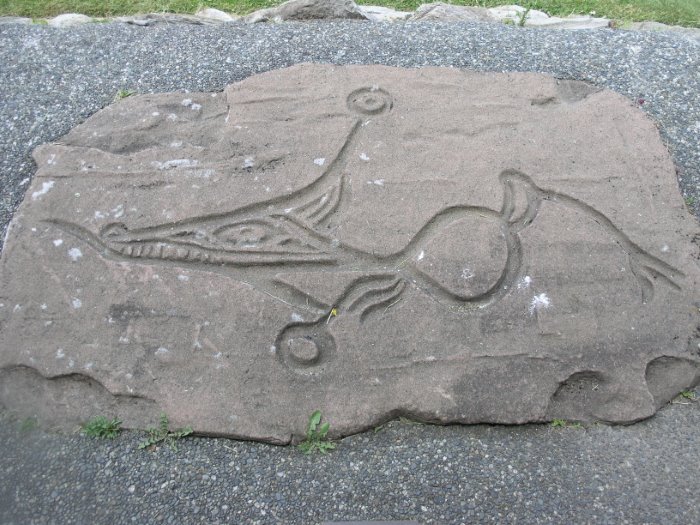
 Associated Canadian Travellers of Nanaimo, Phil Thornburg
,
Petroglyph Replicas,
1967
Ground Plane Art
Concrete
Piper Park
Twelve replicas of regional petroglyphs are carved in sandstone, installed along the sidewalk around the Nanaimo Military Museum. The original petroglyphs are located at several different locations on Vancouver Island: Sproat Lake, Cedar by the Sea, Holden Lake, Englishman River, Petroglyph Park, Harewood area, Ladysmith area, Yellow Island, and Kulleet Bay. Names were given to describe the petroglyphs based on imagined interpretations of what they might represent, though these names have no association with the originally intended meanings of the carvings.
These replicas were called "Sea Creature" (Sproat Lake), "Running Dragon" (Cedar by the Sea), "Dancing Spirit Doctor" (Cedar by the Sea), "Dancing Male Figure" (Holden Lake), "Bear Petroglyph" (Englishmans River), "Man Swallowed by Monster" (Petroglyph Park), "Dancing Man and Snake" (near Harewood), "Guardian Spirits" (near Ladysmith), "Totem-Like Human Figures" (Yellow Island), "Mythological Creatures" (Sproat Lake), "Man & the Sun" (Yellow Island), "Rain God Petroglyph"(Kulleet Bay) by those who commissioned them. They were created because some area residents feared the original petroglyphs would succumb to vandalism or degradation in their actual settings. The replicas were donated to Nanaimo Centennial Museum by the Associated Canadian Travellers of Nanaimo in 1967 to celebrate Canada's Centennial year.
Nanaimo-based sculptor Phil Thornburg, an American immigrant, carried out the project. Thornburg went on to make and sell more replica petroglyphs as souvenirs, in addition to other Indigenous artworks and artefacts, creating a successful business that sold to people across North America. He stated that he did not buy work from or support any of Vancouver Island’s Indigenous nations, instead opting to create a factory where he and his staff made all of their objects out of cheaper synthetic materials.
Search Again

![ParksRec[WestwoodTrail]](https://www.nanaimo.ca/images/page-banners/parksrec-westwoodtrail.jpg)