

Pre-Zoning for Social Housing
Project Complete
On 2026-September-21, Council adopted the "Zoning Amendment Bylaw 2026 No. 4500.256" (Social Housing Zone). The Social Housing Zone forms part of Zoning Bylaw No.4500 and allows an increase in density and building height when social housing is provided on eligible parcels. Social housing means multiple family dwelling units that are subsidized to be lower than the average cost of market housing (excludes supportive housing and shelters). To be eligible for the Social Housing Zone, certain ‘conditions of use’ must be met, which are outlined in the "Zoning Amendment Bylaw 2026 No. 4500.256" (Social Housing Zone).
Thank you to everyone who participated in this initiative. If you have any questions about the Social Housing Zone, please contact Current Planning staff at planning@nanaimo.ca or by calling 250.755.4429 ext. 4509.
About This Initiative
The Pre-Zoning for Social Housing project explored pre-zoning land in certain areas to accelerate the delivery of social housing, by removing the requirements for a rezoning. This initiative was identified as a Council priority action in the 2023 Version of the Integrated Action Plan (Priority Action #69).
The initiative responds to challenges non-profit housing providers have with the timelines associated with rezonings, impacting their ability to secure funding. By streamlining the approval process, this initiative helps projects move forward more quickly.
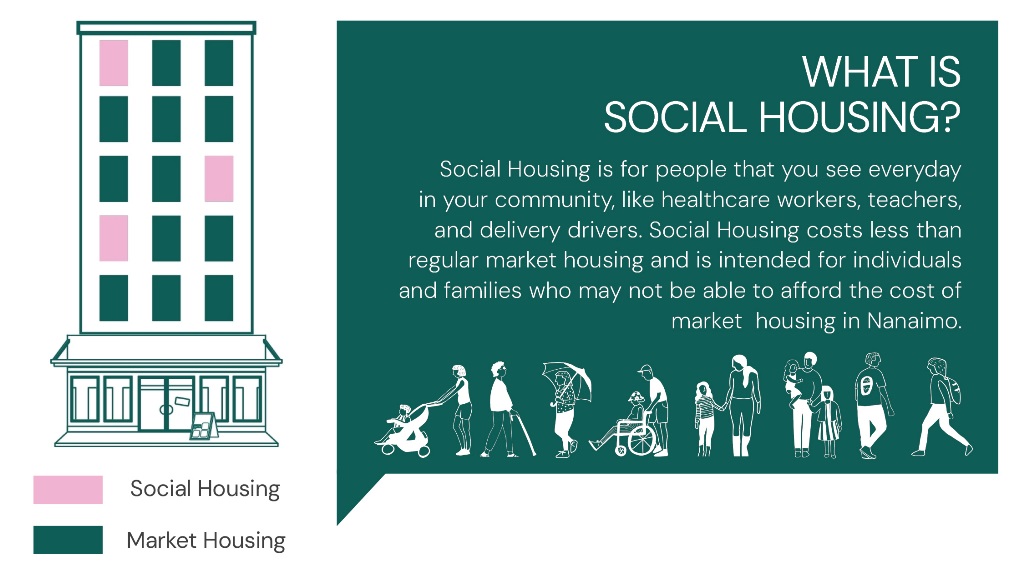
WHAT IS SOCIAL HOUSING?
WHAT IS PRE-ZONING?
Pre-zoning is a planning tool used by local governments to proactively change zoning to align with long-term land use plans, like City Plan, the City’s Official Community Plan. This means developments would not require a rezoning, but still be subject to development permit, works and services agreements and building permit approvals.
GOAL OF PRE-ZONING FOR SOCIAL HOUSING
To pre-zone land to expedite the delivery of social housing, by removing the requirement for a rezoning, where social housing is provided. This initiative responds to a gap in the supply of affordable housing and the challenges non-profit housing providers have in securing fundings to build social housing. By removing the need for a rezoning, projects can move forward more quickly.
This initiative is optional, and incentive based. A property owner can develop under current zoning, or choose to develop under the ' Social Housing Zone'.
HOUSING NEEDS IN NANAIMO
This initiative responds to housing needs identified in the City of Nanaimo's Housing Needs Report (2024):
- The City of Nanaimo will need 12,962 new housing units for 2021-2031 (10-years).
- 7,001 (54%) of the units will need to be non-market housing units.
- Of the 54% of non-market units, 5,784 units (45%) need to be social housing, and 1,217 units (9%) supportive housing.
HAVE ANY QUESTIONS?
Please reach out to staff if you have any questions on this project.
Community Planning
250-755-4464
communityplanning@nanaimo.ca
- Progress
SEPTEMBER 2026 | Council adopted the "Zoning Amendment Bylaw 2026 No. 4500.256" (Social Housing Zone). Click here to view the agenda, meeting minutes and a video of the meeting.
JUNE 2026 | Staff presented the 'What We Heard - Engagement Summary' and the proposed ‘Social Housing Zone’ to Council on June 22, 2026. Council gave first and second reading of “Zoning Amendment Bylaw 2026 No. 4500.256” (Social Housing Zone) and direction to move forward with a public hearing. Click here to view the agenda, meeting minutes and a video of the meeting.
FEBRUARY - MARCH 2026 | Feedback was sought from the community on the draft development framework. A survey was made available from February 23 to March 15th. The results have now been summarized in the 'What We heard - Engagement Summary'.
FEBRUARY 2026 | Feedback was sought from the Public Safety Committee on February 11th, 2026. Click here to view the agenda, meeting minutes and to watch a video of the meeting. Feedback was also sought from the Mayor's Leaders' Table on February 23, 2026. Click here to view the agenda, meeting minutes and to watch a video of the meeting.
JANUARY 2026 |Staff presenting the draft development framework to the Governance and Priorities Committee (GPC) meeting on Monday, January 26th. Click here to view the Staff Report and video.
- Documents
September 21, 2026 | Adopted Social Housing Zone (Bylaw No. 4500.256
September 21, 2026 | Schedule B - Eligible Parcels for Social Housing Zone B4500.256 Social Housing Zone
June 22, 2026 | Staff Report to Council
June 22, 2026 | What We Heard - Engagement Summary
June 22, 2026 | Social Housing Zone | Zoning Amendment Bylaw 2026 No. 4500.256
June 22nd, 2026 | Architectural Testing for Pre-Zoning for Social Housing
March & April 2026 | Pre-Zoning for Social Housing Survey
January 26th, 2026 | Staff Report for Decision | Pre-Zoning for Social Housing
January 26th, 2026 | Pre-Zoning Approaches to Affordable Housing Jurisdictional Scan Summary (Attachment A)
January 26th, 2026 | Link to Map Showing the Scope of the Pre-Zoning Overlay (Attachment B)
January 26th, 2026 | Pre-Zoning Approach for Non-Market Housing Jurisdictional Scan & Discussion Report
- Details
- Background
Give feedback on accessibility. Submit your feedback through our online accessibility feedback form. Help us understand barriers people face when accessing City services.
You can attach files to help explain the barrier you faced in the form, like: a video, voice recording or photos. If American Sign Language (ASL) is the best way for you to communicate, upload a video of yourself using ASL into the form.
Please include: what you were trying to access, where the barrier happened, what the barrier was and any recommendations you might have.
Help us improve our website
Freedom of Information and Protection of Privacy Act Statement:
Information collected on this form is done so under the general authority of the Community Charter and Freedom of Information and Privacy Protection Act (FOIPPA), and is protected in accordance with FOIPPA. Personal information will only be used by authorized staff to fulfill the purpose for which it was originally collected, or for a use consistent with that purpose.
For further information regarding the collection, use, or disclosure of personal information, please contact the Legislative Services Office at 250-755-4405 or at foi@nanaimo.ca
-
Parks, Rec & Culture
- Recreation Facilities & Schedules
- Parks & Trails
- Trails
- Activity Guide
- Events
- Register for a Program
- Drop-In Schedules
- Public Art
- Culture
- Poetry
-
City Services
- Recycling, Compost and Garbage
-
Home & Property
- Change Your Address
- Damage/Injury Claims
- City Charges and Your Property Title
- Pre-Authorized Withdrawals (PAWS)
- Property Taxes
- User Rates
- Dog Licences
- Payment Options
- MyCity
- Water & Sewage
- Online Services
- Cemetery Services
- City Services Directory
-
Property & Development
- Urban Forestry
-
Building Permits
- Online Building Permit Application
- Building Permit Revision
-
Application for a Residential Building Permit
- Access (driveway) Permit
- Accessory Building Permit
- Alteration Permit
- Building Envelope Repair
- Carriage House
- Demolition Permit
- Fence or Retaining Wall Permit
- Geotechnical Reports
- Locate Permit
- New Construction Permit
- Plumbing or Services Permit
- Secondary Suite Permit
- Special Inspection Permit
- Swimming Pool Permit
- Woodstove Installation Info
- Green Home Initiatives
- Small-Scale Multi-Unit Housing (SSMUH) Permit
-
Apply for a Commercial Building Permit
- Access (driveway) Permit
- Commercial Alteration Permit
- Building Envelope Repair Permit
- Demolition Permit
- Fence or Retaining Wall Permit
- Geotechnical Reports
- Leasehold Improvement
- Locate Permit
- New Commercial Construction Permit
- Occupant Load Permit
- Signs Permit
- Special Inspection Permit
- Sprinkler Requirements
- Fees and Bonding
- Commercial Plumbing Permit
- Certified Professional Program
- Bylaws for Building
- Forms and Guidelines
- Book a Building Inspection
- Report Illegal Construction
- Request Building Plans
- Building Permit Statistics
- Permit Fee Calculator
- Building News and Alerts
- Fast Track Building Permits
- Development Information
- What's Building in my Neighbourhood
- NanaimoMap
- Development Cost Charges
- Community Planning
- Rebates
- Engineering Survey
- Land Use Bylaws
- Soil Removal and Depositing
- Sustainability
- Transportation & Mobility
-
Your Government
- Get Involved
- Government Services Guide
- News & Events
-
City Council
- Advocacy
- Contact Mayor & Council
- Council Meetings
-
Boards & Committees
- Advisory Committee on Accessibility and Inclusiveness
- Board of Variance
- Design Advisory Panel
- Finance and Audit Committee
- Governance and Priorities Committee
- Mayor's Leaders' Table
- Parcel Tax Roll Review Panel
- Special District 68 Sports Field and Recreation Committee
- Public Safety Committee
- Understanding Council Committee Structures
- Council Policies
- Mayor's Office
- Council Initiatives
- Proclamations
- Bastion Lighting Requests
- Flags at City Hall
- Alternative Approval Process
- Budget & Finance
- Records, Information & Privacy
- Elections
- Contacts
- Careers
- Maps & Data
- Projects
- Tourism Nanaimo
- Grants
- Awards
- Accessibility & Inclusion
-
Doing Business
- Economic Development
- Doing Business with the City
- Business Licences
- Filming in Nanaimo
- City Owned Property
- Encroachments onto City Property
- Liquor Licences
- Cannabis Retail
- Business Improvement Areas
- Procurement Services
- About Nanaimo
- Green Initiatives
-
Public Safety
- Social Development
- Public Safety Contacts
- Nanaimo Fire Rescue
- Emergency Management
- Police & Crime Prevention
- City Bylaws
- Community Safety and Wellbeing
- Emergency Services