
Q&A Water Treatment Plant
Water Treatment Plant and Alternative Approval Process
BACKGROUND
To comply with changes to the City's Permit to Operate a Water Supply System, the City is required to build a Water Treatment Plant (WTP) by March 2015. In addition to the timeline, the Operating Permit requires two types of treatment, one of which is filtration. The City currently has a single type of water treatment - chlorination. The project will be funded from senior government grants, development cost charges, water user rates, and borrowing of up to $22.5 Million. Approval of the electors must be obtained to borrow, and Council has decided to obtain this approval with an alternate approval process (AAP).
More information on the AAP or the WTP, and forms to object to the borrowing bylaw can be found in two places:
- Legislative Services Front Counter at City Hall, 455 Wallace Street, or
- On the City's website http://www.nanaimo.ca/ under Municipal Hall and then click Municipal Elections
QUESTION & ANSWER
This Question and Answer sheet was prepared to address questions that may come up, and to inform the public about the project and the AAP.
ALTERNATIVE APPROVAL PROCESS
1) What is an Alternative Approval Process and how does it work?
An Alternative Approval Process (AAP) is a method provided to municipal governments within the Community Charter to obtain approval in regards to certain types of proposed bylaws, agreements or other matters. It is commonly used in relation to long term borrowing bylaws.
After the City publishes the second official notice publicizing the AAP, electors have thirty days to submit an Elector Response Form opposing the bylaw. If ten percent (6,268) of electors indicate they are opposed to the loan authorization bylaw, Council will have to seek approval in another way (referendum) or not proceed with the bylaw (find another way to raise the funds).
2) What is the difference between a referendum and alternative approval process?
In a referendum each registered voter may participate by answering yes or no to a specific question on a ballot. An alternative approval process requires that those electors in opposition to that particular question sign petitions registering their objection.
3) What statement are people being asked to consider in this AAP?
If people object to the borrowing bylaw, they need to fill out an 'Elector Response Form' (available at City Hall in the Legislative Services Department or at the City's Website). The form states:
· "I am OPPOSED to the adoption of "WATER TREATMENT PLANT LOAN AUTHORIZATION BYLAW 2011 NO. 7127", which authorizes the borrowing of $22.5 Million for the purpose of constructing a water treatment plant, without first obtaining the assent of the electors in a voting proceeding. (referendum)"
4) What would be the next step if the required 10% of the resident voters submits an electoral response form?
Council would decide whether to hold a referendum at the same time as the general municipal elections in November 2011 or raise the required funding by another means, such as increased water rates, property value taxes, parcel taxes or some combinations thereof.
5) If borrowing is not supported what would the cost of the options to pay for the WTP be to individual home owners/ water rate payers?
If borrowing is not supported, options exist for raising the required funds. Examples include:
(i) If raised through user fees, then all water users will receive a rate increase of approximately 80% in 2012. This increase will remain in effect for three years in order to raise the required $22.5 million. For a single family home using an average of 220 gallons of water per day, this would be an increase of about $250 per year. Higher water users will have larger increases. Note, even if borrowing is approved, there will be a 5% increase in water rates each year for at least five years to raise enough money to service the annual debt payments.
(ii) If raised through property taxes, then all property owners would receive an estimated 28% property increase, for one year only (probably 2013) to raise the $22.5 million. Another option would be to spread the tax increase over two years: 2013 - 2014.
(iii) If raised by a parcel tax, then each property in the City would pay a one-time parcel tax of about $650, regardless of the assessed value of the property.
(iv) A combination of the above could be considered by Council.
6) Why borrow the $22.5 million rather than raise the funds some other way?
Borrowing allows the City to pay off the loan over 20 years which is more affordable for most ratepayers. In this way, future users who will benefit from the investment made will also contribute to the plant. Should the $22.5 million be raised over 1 to 3 years to pay for the WTP, ratepayers who are in Nanaimo today will pay for a plant which will be used by future generations or new residents. It should be noted that the City is borrowing $22.5 million and not the total value of the project.
The cost of borrowing is included in the annual 5% water rate increase noted above.
PLANNING AND COSTS
7) Why is the City building a Water Treatment Plant?
Regulation of drinking water quality is a provincial responsibility. Each province and territory has developed legislation and/or policies to protect the quality of drinking water from source to tap. All jurisdictions base their requirements on the Canadian Drinking Water Quality Guidelines and enforce them through legislation, regulation or permitting.
In BC, the authority for regulating drinking water quality rests with the Ministry of Health. In most Canadian communities, drinking water is treated, stored and delivered to homes and business by a Local Government, as in the City of Nanaimo. Local governments manage the day-to-day operation, maintenance and monitoring of the drinking water treatment and distribution to ensure the water reaching consumers meets the required drinking water quality standards. The Water Quality Standards for Nanaimo are established by the Vancouver Island Health Authority (VIHA) and are outlined in our permit to operate a water supply system. (See the City website at www.nanaimo.ca)
VIHA notified the City in 2008 that it had approved a new treatment standard for surface water supply systems. This treatment standard is a requirement throughout the province of BC. On Vancouver Island, all surface water systems serving over 500 people have had their operating permits modified to meet this treatment standard. The purpose of the policy is to add additional barriers in the multi-barrier approach to safe drinking water.
The City of Nanaimo's water supply is protected from bacteria by means of a single treatment process being chlorination. The majority of waterborne illness outbreaks in jurisdictions throughout North America are associated with surface water supplies with a similar treatment process as our City currently operates. A second barrier, in this case a filtration plant, will significantly reduce the associated risks of a potential waterborne illness for the City's population and bring the City's treatment processes up to Canadian Drinking Water Quality Guidelines.
To comply with VIHA's treatment standard, the City as the water system owner is required to provide two treatment processes including filtration. The permit also includes a condition to meet a schedule for the design, construction and start up of a water treatment plant. The City must construct the plant because the terms and conditions on the Operating Permit are legally binding.
8) What will be the cost of the water treatment plant project?
The full cost of the project is estimated to be $65 million dollars. $3 million of that amount has been spent to date on pilot testing, design and property acquisition.
9) What will it cost to operate the plant?
The operating expenditures for the WTP are estimated at $1.8 million per year.
10) Where are the funds for the project coming from?
The funding is broken down as follows:
- $17.8 Million- Building Canada Fund (Federal & Provincial Governments)
- $10.0 Million- Community Works Fund (Federal Government)
- $5.9 Million- Development Cost Changes
- $8.8 Million- Water rate revenues
- $22.5 Million- Proposed to be long term borrowing OR water rate increase
11) Is the Province contributing to the funding of the WTP as they are requiring us to build it?
In 2008, the City applied for grant funding under the Building Canada Fund which is a provincial and federal fund for new infrastructure. In April 2009, the City was notified by the Province that it was successful in receiving $17.8 million. That $17.8 million consists of $8.9 million contributed from each of the provincial government and the federal government.
12) What is the difference between the water treatment system we have now and what the proposed plant will do?
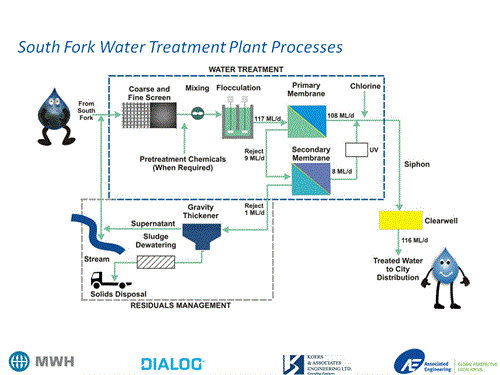
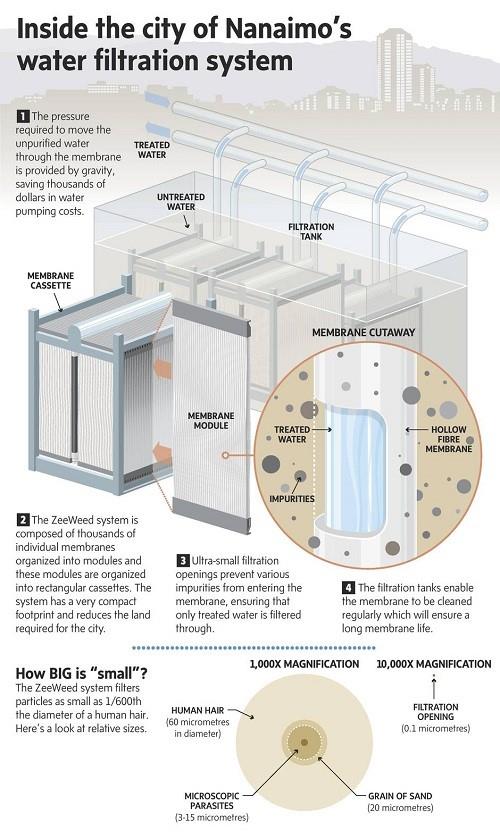
Currently, the City has a single form of treatment: coarse screening to keep out large debris that may be present in the water and followed by chlorine injection. This helps kill viruses and bacteria. The level of filtration the water will pass through to will be much higher within the proposed plant. The WTP will filter the water to screen out minute particles including pathogenic (disease-causing) organisms (Cryptosporidium, Giardia).
The proposed WTP will provide a multi-barrier approach to safe drinking water which is practiced across North America. A multi-barrier approach greatly reduces risks to safe drinking water.
13) Why build the WTP now?
The City's Permit to Operate a Water Supply System sets out milestone deadlines, which the City must meet with to be in compliance with the Drinking Water Protection Act. The Operating Permit requires that the WTP be functioning by March, 2015.
14) Does the plan for the Water Treatment Plant take future growth of the city into account?
The WTP is designed to have the capacity for the city's population growth up to 124,000 people or approximately until the year 2035. The plant is being designed so that it can be expanded to accommodate future growth.
15) What are the project timelines?
The project is currently in design. Detailed design is anticipated to be completed in late summer 2012. Following that, there will be a public tender process. Construction is scheduled to begin either late in 2012 or early 2013. It is expected that construction will continue until the close of 2014 followed by commissioning by March 2015. This timeline will achieve compliance with the dates set out in the City's revised operating permit.
16) Where will the Water Treatment Plant be built?
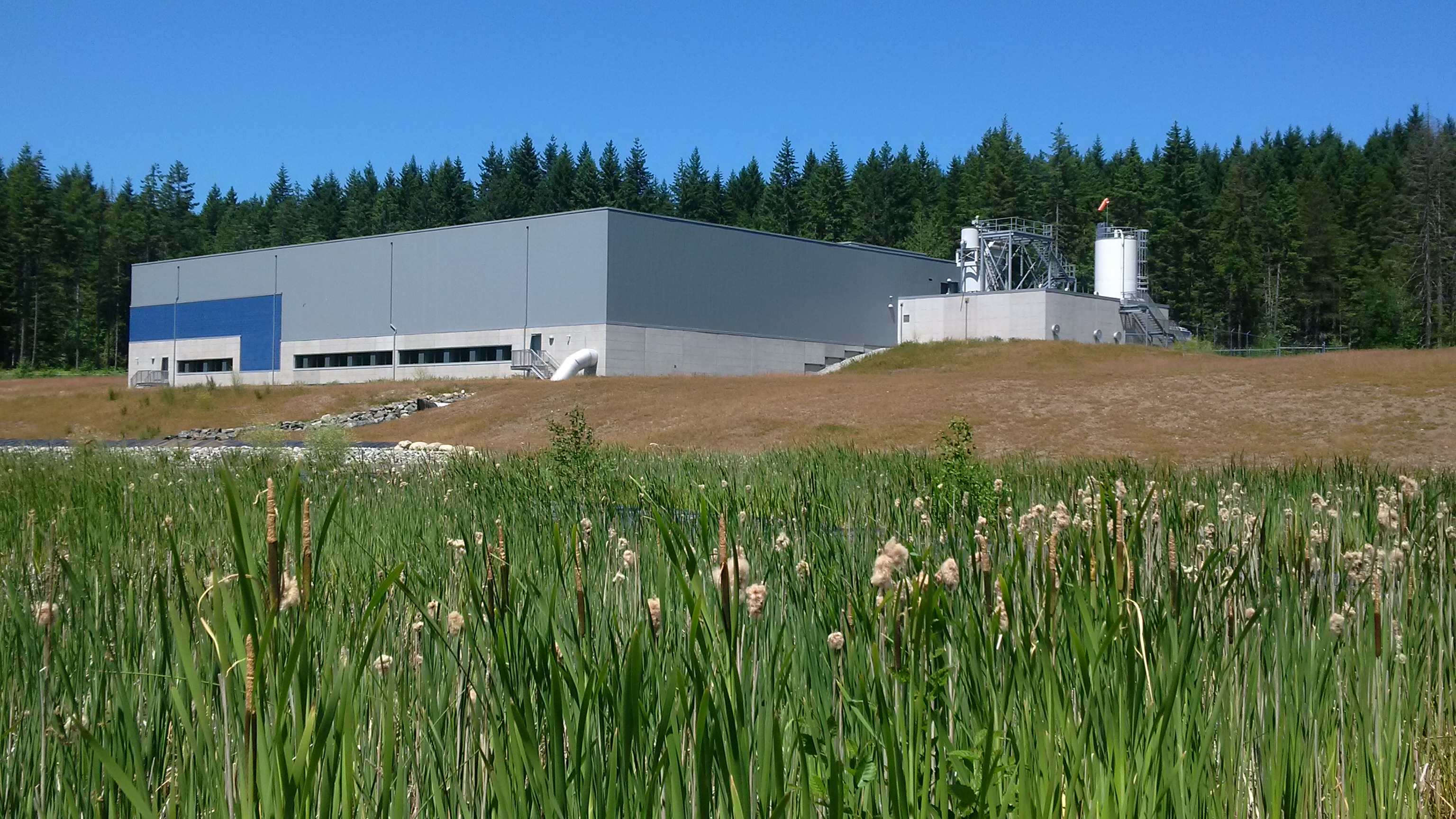
The WTP will be built 2 km north of Nanaimo River Rd on South Forks Road (see website for location)
REGULATIONS
17) What would happen if the City did not build the new Water Treatment Plant?
The Province, through VIHA, has a number of legal options available to them to ensure the operating permit terms andconditions are met. These actions could include fines, court proceedings or an Order under the Drinking Water Protection Act.
18) What is VIHA's role in this and how can they enforce a WTP?
VIHA, in accordance with the Drinking Water Protection Act has jurisdiction of enforcing the Act. VIHA developed a policy to set the standard for drinking water and require that all municipalities provide filtration or at least two types of treatment on their water supplies.
Excerpts from the Drinking Water Protection Act:
Water supply systems must provide potable water
6 Subject to the regulations, a water supplier must provide, to the users served by its water supply system, drinking water from the water supply system that
(a) is potable water, and
(b) meets any additional requirements established by the regulations or by its operating permit.
Operating permits and requirements for water supply systems
8 (1)In the case of a prescribed water supply system, the water supplier
(a)must not operate the water supply system unless the water supplier holds a valid operating permit issued in accordance with the regulations,
(b)must comply with all terms and conditions of its operating permit, and
(c)must operate the water supply system in accordance with any applicable regulations.
19) Have other communities had to make upgrades to their water systems similar to the expectations being placed on Nanaimo?
VIHA has stated this policy has been applied to 22 water systems on Vancouver Island since 2007. As well, this policy has been applied as a performance target for all new surface water systems, regardless of size, since 1997.
This treatment standard is a requirement throughout the province of BC. It is also important to note that BC is one of the last jurisdictions in North America, in fact amongst most developed countries, to adopt these treatment standards.
20) Is a WTP the only option to achieve the policy set by the Ministry of Health?
In the City of Nanaimo's case, a water filtration plant is the only means of achieving the policy set out by the VIHA, because raw water turbidity is higher than the standard.
21) Why doesn't the City meet criteria to defer filtration to another time?
The policy requires treated water be less than 1 NTU at all times. Currently, the City's water exceeds 1 NTU an average of 35 days per year, and exceeds 5 NTU 5-8 days per year. 'NTU' is a measure of turbidity or suspended particles in the water. In extreme weather conditions, the raw water can exceed 50 NTU. The second criterion is that the City only has a single form of treatment (chlorine disinfection).
22) What is the treatment standard required by the policy?
The policy requires water system owners to achieve a 4-logarithm (99.99%) removal / inactivation of viruses, a 3-logarithm (99.9%) removal / inactivation of Giardia cysts and Cryptosporidium oocysts, provide 2 forms of treatment and produce a finished water quality with less than 1 NTU of turbidity.
23) Why is turbidity such a concern in our raw drinking water?
Turbidity is an important water quality indicator because contaminants such as bacteria and viruses can attach themselves to the suspended particles in turbid water.These particles can interfere with disinfection and in turn could allow microorganisms into our treated water supply. Turbidity spikes in our watershed were the reason for the majority of our Boil Water Advisories in the past. A filtration plant would ensure that the turbidity levels will be reduced to manageable levels year round.
24) Is the drinking water in Nanaimo unsafe?
In general, both the City and VIHA agree that water quality is excellent. To date there have been no outbreaks that we are aware of due to water-borne disease in the City's drinking water. However, the City's drinking water does not meet the current Canadian Drinking Water Quality Guidelines or the Drinking Water Protection Act, due to most notably, turbidity during the winter time but also that there is no protection against pathogenic organisms such as Giardia or Cryptosporidium.
25) If I have questions, who do I contact?
Go to TopIf you have questions regarding the WTP, please contact the City's Water Resources Manager, Bill Sims at 250-758-5222.
If you have questions regarding the AAP, please contact Joan Harrison in the City's Legislative Services Department at 250-755-4405.